
Practical Meditation from Classical Yoga
Insight into Reality – The Tantric teachings of the Vigyana Bhairava Tantra
Background to the text

The Vigyana Bhairava Tantra was written about 1000 years old in Kashmir.
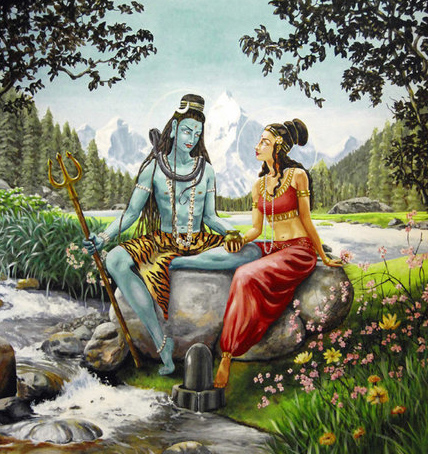
It has a mythical setting, the God, Shiva and Goddess Shakti are sitting in the Himalayas discussing the nature of reality.
They are man and wife but also represent bigger concepts.
Shiva represents Consciousness or to use another Sanskrit term Purusha.
Shakti represents Cosmic energy from which everything in the manifest universe comes from, Prakriti.
Shakti asks Shiva about the nature of reality. She explains that she has intellectual understanding but that her mind is full of doubts.
Shiva in answer gives her 112 Dharana (concentration / meditation) practices to do, through which she (and by implication all of us) can gain insight through experience.
The translation used is by Swami Nishchalananda Saraswati. He says in his commentary “Consciousness can never by explained in words”. Swami Nishchalananda has written a wonderful and practical commentary on the text which is available from the Mandala Yoga Ashram in Wales.
To explain the title of the text:
Vigyana = means insight.
Bhairava = Consciousness
Tantra = a practical system to expand our awareness.
So the Vigyana Bhairava Tantra is a practical teaching on how to gain insight into Consciousness. Swami Nischalananda’s translation is called “Insight into Reality”.
Here a few of the Dharana practices with some tips on how to practice them.
Dharana 1
“O Beloved, insight may arise between two breaths. Be aware of the point from where the breath comes in, and the point into which the breath goes.”
How to practice
This works really well with Trikon breathing and other practices involving awareness of breath in the nostrils. Awareness following the breath as it moves from the space outside the nostrils, through the nostrils to the eyebrow centre and out into the space again
Dharana 2
“Be aware as the breath turns from out to in and again as the breath turns from in to out.”
How to practice
The ‘Pendulum breath’ : After each in breath be aware of a pause, imagine a pendulum hanging in the air for a moment before it swings the other way as you breathe out, and again be aware of the pause as the pendulums hangs in the air before the next breath in.
Dharana 3
“Be aware of the inner space where the in-breath fuses with the out-breath. This can transform into ‘kevala kumbhaka’ where there are no thought patterns. Here, there seems to be no energy and yet it is the source of energy.”
How to practice
This is just effortless breathing really, breath awareness allowing the natural pauses between the breath to develop. Aware of those pauses where the body is still and the breath is still, those prana full moments.
Dharana 55 (Just sit and be still)
“With the feet or hands relaxed, sit in a comfortable position on one buttock.
Be still and be filled with plenitude.”
How to practice
Most meditation practices need stillness. The practice of Kaya Sthairyam/Body stillness involves concentration on the sensory experiences of sitting still.
Dharana 16
“Chant the mantra OM, or any other sacred mantra. Contemplate on the stillness and spaciousness at the end. Through this underlying stillness, merge with plenitude”.
How to practice
There are many ways to practice Om. You can chant audibly or mentally. Also you can use the 3 sounds of Om, Ahh, Ooo and Mmm.
Dharana 24
“Feel as though the different parts of your body are permeated by spaciousness. Become steady in this contemplation”.
How to practice
This dharana relates very well to the practice of Yoga nidra. When we move awareness around all the different parts of the body that gives us a sensation of spaciousness as if the body was full of space and in that space there is Prana/vital energy.
Dharana 25
“Contemplate the skin as a membrane. Feel as if there is nothing substantial inside it. Remain in this state which transcends form”.
How to practice
This ones works very well as a relaxation practice in Shavasana. Be aware of body floor contact, sounds around you, then be aware of touch sensations on the skin, then aware of stillness of the body of the body and the movement of the body as it breathes, then imagine the skin is like a breathable membrane, and that the whole body is breathing. Skin is all that is separating space around you from the space within.