



The Magic of Mudras – how they work

“Mudras are a combination of subtle physical movements which alter mood, attitude and perception and which deepen awareness and concentration”
from Asana Pranayama Mudra Bandha
For most of us, our first introduction to mudras is the Hasta Mudras (literally ‘hand gestures’) but there are other mudras that use other parts of the body.
- Shirsha (head) mudras
- Bandha (lock) mudras
- Adhara (perineal) mudras
- Kaya (body) Mudras
“Mudras are so valuable because they enhance overall wellbeing and allow you to tap into hidden energy reserves. Absolutely anyone can benefit, from children with learning disabilities to older people with limited movement.”
Swami Saradananda
One of the ‘magic’ properties of Mudras is that they have such a deep effect so very quickly. This makes them an invaluable tool to help find balance, grounding, peace at any time of the day.
But how do they work?
Mudras and the Brain
The Cerebral Cortex
This is the outermost wrinkly layer of the brain. It is where thoughts take place. The Cortex is responsible for thinking, speech, decision making and for processing information from the senses. The more knowledge we acquire in life the more wrinkly the cortex becomes.
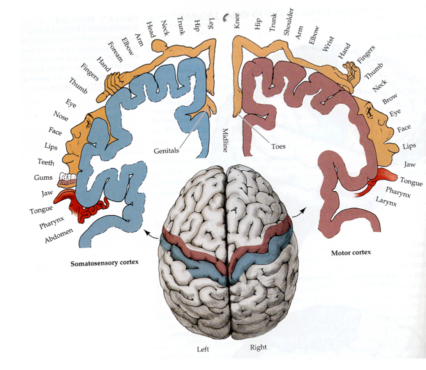
Neuroscience has shown that each part of the body is precisely mapped out along the surface of the central fold of the sensory motor cortex.

This is called the homunculous or the ‘little man’.
The head and hands take up about 50% of the cortex the rest is for all the other parts of the body.
“The mudras for eyes, hands, tongue and genitals aim at controlling and bringing awareness to large areas of the cortex and sensory motor area of the brain”.
MudraVigya p34
The Medulla Oblongata
The more primitive areas of the brain are around the Brain stem. The Medulla Oblongata is the most important part of the brain as we would not be able to live without it. It regulates life sustaining functions, breathing, swallowing and heart rate. It also helps transfer messages from the brain to the spinal cord.
“Mudras provide a means to access and influence the unconscious reflexes and primal, instinctive patterns of habit that originate in the primitive areas of the brain around the brain stem. They establish a subtle, non- intellectual connection with these areas.”
(Mudra Vigyan pg 32)
Central Nervous system
Communication between the body and the mind goes mainly through the Central Nervous System.
When a mudra is performed, neural impulses are firstly generated in the brain. For example, for an eye mudra the message goes from the motor cortex through neural pathways to the eyes. Then the impulses are sent back to the brain. This creates a loop through which nerve energy moves in a circular pattern, gradually building up the energetic charge throughout the neural circuit formed by the mudra.
How mudras work energetically
The Yogic explanation of how mudras work is more concerned with energy/Prana.
Prana is our vital energy/life force. Prana builds up as it circulates through the neural loop created by the mudra.
This can be summed up in the phrase “Where your awareness goes, energy flows.”
“Mudras manipulate prana in much the same way that energy in the form of light or sound waves is diverted by a mirror or a cliff face. The nadis and chakras constantly radiate prana which normally escapes from the body and dissipates into the external world. By creating barriers within the body through the practice of mudra the energy is redirected within.”
(Prana Pranayama Prana Vidya)
Do we need to know how mudras work?
It is always interesting to find out how exactly how our bodies and minds work. However in yoga there is a lot to be said for the ‘suck it and see’ approach.
Just doing our practice and experiencing for ourselves the effects without expectation, and without our intellect and what we believe or don’t believe interfering with our experience.
As humans while we are on these bodies we will never really have a full picture of the nature of reality. There is always lots of stuff we will never fully understand. Mudras are very much like this and that is part of the ‘magic’ of mudras.


