



Yoga Philosophy & the Upanishads
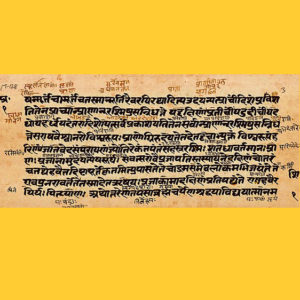
Of all the ancient yogic texts the Upanishads are the ones which tried to answer the big questions of life.
- Where did I come from?
- Why am I here?
- Where am I going?
The answers given in the Upanishads are that our inner self is changeless, we have never not been ‘here’. They teach us that while we are here in our bodies our purpose is to live with a realisation that we are inner light, that in death our bodies die but our inner self remains unchanged.
There is a beautiful simplicity in this message.
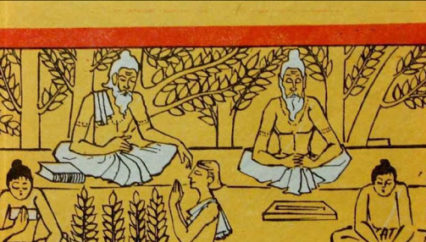
The Upanishads are more than 3000 years old. The translation used here is by Eknath Easwaran. He describes the Upanishads as the earliest living records of what Aldous Huxley called ‘the Perennial Philosophy’, the conviction, marked by personal experience, that there is a spark of the Divine in every creature, and that to realize this divinity is life’s highest goal.
The Upanishads are a collection of texts. In each of these texts different metaphors and language are used to help express the concept of an inner self. Often the inner self is described as light within the heart space.
This image of an inner light at the heart appears in many other spiritual disciplines. Eg: Jesus and Mary are often pictures revealing light shining out from their hearts.
Here are a few examples:
From The Forest of Wisdom – Brihadaranyaka Upanishad :
Janaka asks “Who is that Self?”. The sage answers “The Self, pure awareness, shines as the light within the heart, Surrounded by the senses, Only seeming to think, seeming to move, The Self neither sleeps nor wakes nor dreams”.
(Chapter 4 verse 7)
From the Mundaka Upanishad :
“Bright but hidden, the Self dwells in the heart.
Everything that moves, breathes, opens and closes lives in the Self.
It is the source of love and may be known through love but not through thought.
It is the goal of life. Attain this goal!
The shining Self dwells hidden in the heart.
Everything in the cosmos, great and small, lives in the Self.
It is the source of life, Truth beyond the transience of this world.
It is the goal of life, Attain this goal!” (Part 2)
From Chandogya Upanishad (The sacred song) :
“In the city of Brahman is a secret dwelling, the lotus of the heart.
Within this dwelling is a space, and within that space is the fulfilment of our desires.
What is within that space should be longed for and realized.
As great as the infinite space beyond is the space within the lotus of the heart.
…..
“never fear that old age will invade that city;
Never fear that this inner treasure of all reality will wither and decay.
This knows no age when the body ages; this knows no dying when the body dies”.
Oneness
Another way of describing ‘inner self’ is the term ‘inner consciousness’.
The understanding in the Upanishads is that our inner consciousness is the same as universal consciousness. It is just ‘inner consciousness’ while we are in these bodies but comes from ‘universal consciousness’ and returns to ‘universal consciousness’.
This leads to the idea that we are all the same, we are all one. Again this idea of oneness is common to many belief systems.
Here are some examples from the text:
The Isha Upanishad (The Inner Ruler) :
“Those who see all creatures in themselves and themselves in all creatures know no fear.
Those who see all creatures in themselves and themselves in all creatures know no grief.
How can the multiplicity of life delude the one who sees its unity”.
From The Forest of Wisdom – Brihadaranyaka Upanishad :
“Those who realise the Self enter into the perfect peace that brings complete self-control and perfect patience. They see themselves in everyone and everyone in themselves”.
(Chapter 4)
Philosophical musing on ‘life, the universe and everything’ is all very interesting and it’s good to keep an enquiring mind, but yoga is a practical science so here are a few ideas for putting the ideas from the Upanishads into practice :
Heart space Yoga / Keeping your inner light bright / developing Oneness in Daily life :
- Develop the attitude of joyful renunciation/witness.
“All this whatsoever moves in the Universe is indwelled by Consciousness
Therefore enjoy what is but with the attitude of joyful renunciation” (Ishavasya Upanishad verse 1)Whilst fulfilling all our duties without negligence or half-heartedness, we needn’t take life so seriously.
(Swami Nischalananda in VBT) - Chanting can help us to connect with Oneness to feel less separate. Separateness leads to suffering. Especially mantra OM helps to unite inner consciousness with Universal Consciousness.What else do you do that increases feeling of Oneness? Music, art, dance etc
- LOVE “the self may be known through love but not through thought”
- Connecting with Nature and our fellow animals. “Those who see all creatures in themselves and themselves in all creatures know no fear”.
- MEDITATION – main purpose of meditation is to develop Oneness.
- Be loving to yourself and laugh at yourself!
- Develop Equanimity“Be the same, to friend and foe, in honour and dishonour. Knowing that everything is Consciousness. Be fulfilled and happy.” (Dharana 100 Vigyana Bharaiva Tantra).
- Pratipaksha Bhavana
“There is a term in yoga, pratipaksha bhavana, opposite thinking. When a negative thought comes up, counteract it with a positive thought. You are not resisting or blocking the negative thought. The flow of thoughts continues, but with the help of awareness you allow positive thoughts to be born in place of negative thoughts.”
Swami Niranjanananda (Mind, Mind Management & Raja Yoga)pg 139. - Light a candle – when you do your practice as a reminder of inner light.


